Scientific Events

Nanoengineering of high strength steels

  • Date: Jan 23, 2026
  • Time: 01:30 PM - 02:30 PM (Local Time Germany)
  • Speaker: Univ.-Prof. Wenwen Song
  • Institute of Materials Engineering, University of Kassel
  • Location: Max Planck Institute for Sustainable Materials
  • Room: Large Conference Room No. 203
  • Host: on invitation of Prof. Gerhard Dehm
The diversities in crystalline structure and the hierarchical features of the structures in steels lead to their distinguished deformation behaviour, elastic properties, magnetic properties, mechanical properties, etc. In the research of steels, the linkage of structure-processing-property-performance-circularity is considered as the very important principle to understand the alloys. Following this basic principle, one can further design, select and assess suitable materials for a specific application. Over the last decades, based on multi-scale understanding - from metre to micrometre and further down to nanometre and atomic-scale, a number of extraordinary steels have been successfully developed and commonly applied globally. This research work will present the alloy design, multi-scale characterization and nano-engineering approaches that offer new opportunities to design and engineer the sustainable steels into hierarchical structures with tailored properties. New approach that aid controlling the process of phase transformation in tramp element tolerant steels will be discussed. [more]

Sintering Fundamentals of Nano-Metallic Particle Interconnects

  • Date: Nov 5, 2025
  • Time: 02:00 PM - 03:00 PM (Local Time Germany)
  • Speaker: Dr. Leiming Du
  • Postdoctoral Researcher in the Department of Microelectronics at the Delft University of Technology, in Netherlands
  • Location: Max Planck Institute for Sustainable Materials
  • Room: Large Conference Room No. 203
  • Host: on invitation of Dr. Anwesha Kanjilal and Prof. Gerhard Dehm
Sintered copper (Cu) nanoparticles have emerged as a promising substitute for sintered silver (Ag) nanoparticles in power electronics packaging, offering comparable electrical and thermal conductivities, superior mechanical strength, and lower cost. However, the complex interactions between microstructure evolution, interfacial bonding, and mechanical performance during sintering remain insufficiently understood. This research investigates the mechanical behavior, fracture mechanisms, and reliability of sintered Cu nanoparticles through a combination of microscale experiments and multiscale modeling. The studies revealed the anisotropic fracture toughness of sintered Cu nanoparticles, developed an Anand viscoplastic model to describe high-temperature deformation, and quantified interfacial strength while elucidating the effects of oxidation on bonding quality. Furthermore, the influence of particle morphology on mechanical properties was examined using micro-cantilever bending tests and phase-field fracture simulations. Overall, this work advances the understanding of sintered Cu nanoparticles and supports the development of reliable and cost-effective interconnect materials for next-generation power electronics. [more]
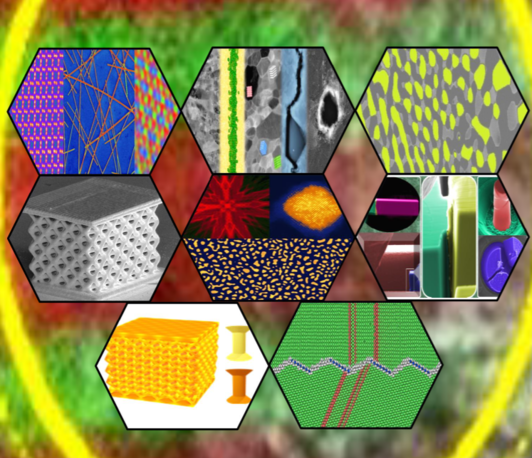
Ancient craft, new perspective: Recovery and recrystallization of deformed metal nanoparticles

  • Date: Oct 29, 2025
  • Time: 11:00 AM - 12:00 PM (Local Time Germany)
  • Speaker: Dr. Jonathan Zimmerman
  • Postdoctoral fellow at the Max Planck Institute for Medical Research, Heidelberg, Germany
  • Location: Max Planck Institute for Sustainable Materials
  • Room: Large Conference Room No. 203
  • Host: on invitation of Prof. Gerhard Dehm
Metallic nanoparticles are utilized in a growing number of applications due to their unique and tunable properties. However, one of the primary tools used to tune bulk metals properties, recrystallization, is yet to be used in the case of nanoparticles. We studied pristine, single crystal platinum nanoparticles during a recrystallization annealing after deformation. We found that deformation causes a dramatic change in particles orientation, while annealing induced a plethora of different particle behaviors. Microstructurally, nucleation of new grains was observed, but in the smallest particles these new grains were quickly absorbed back into the deformed matrix. We describe a phenomenological kinetic model to explain the strong correlation between the particle properties and their annealing behavior. [more]

Challenges and Perspectives for the Development of High Temperature Materials

Colloquia Series on Sustainable Metallurgy
  • Date: Oct 21, 2025
  • Time: 04:00 PM - 05:00 PM (Local Time Germany)
  • Speaker: Prof. Alexander Kauffmann, Materials Science and Engineering, Ruhr University Bochum
  • Location: Max Planck Institute for Sustaianble Materials
  • Room: Hybrid / Large Seminar Room No. 203
  • Host: Prof. Erik Bitzek
  • Topic: Lectures

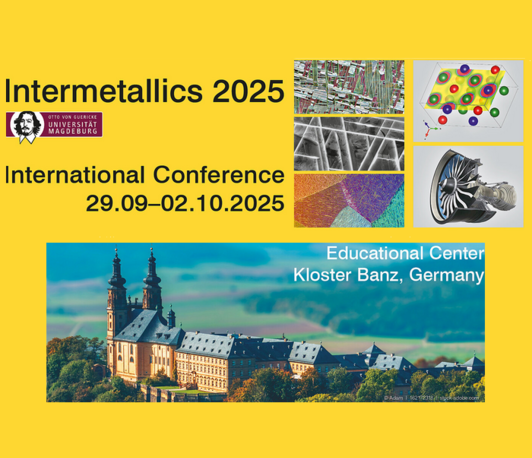
"Intermetallics 2025"

  • Start: Sep 29, 2025
  • End: Oct 2, 2025
  • Location: Educational Center Kloster Banz, Bad Staffelstein, Germany
  • Host: Manja Krüger, Martin Heilmaier, Florian Pyczak, Martin Schloffer, Andre Schneider, Frank Stein

It's all about transitions - dealing sustainably and reliably with critical metal oxides in simulations and technologies

Colloquia Series on Sustainable Metallurgy
  • Date: Sep 9, 2025
  • Time: 04:00 PM - 05:00 PM (Local Time Germany)
  • Speaker: Prof. Lucio Colombi Ciacchi, Hybrid Materials Interfaces, University of Bremen
  • Location: Max Planck Institute for Sustainable Materials
  • Room: Hybrid / Large Seminar Room No. 203
  • Host: Erik Bitzek
  • Topic: Lectures
  • Contact: susmet@mpi-susmat.de

IPAM Workshop: Bridging the Gap - Transitioning from Deterministic to Stochastic Interaction Modeling in Electrochemistry

IPAM Workshop on Electochemistry
  • Start: Sep 3, 2025
  • End: Dec 12, 2025
  • Location: UCLA, Los Angeles, CA, USA
Organised by: Jörg Neugebauer (Max-Planck-Institut for Sustainable Materials), Juergen Fuhrmann (Weierstraß-Institut für Angewandte Analysis und Stochastik (WIAS)), Richard Hennig (University of Florida), Mauro Maggioni (John Hopkins University)Keith Promislow (Michigan State University), Katsuyo Thornton (University of Michigan)Bilge Yildiz (Massachusetts Institute of Technology) [more]
Show more
Go to Editor View