Scientific Events

Location: Max-Planck-Institut für Eisenforschung GmbH
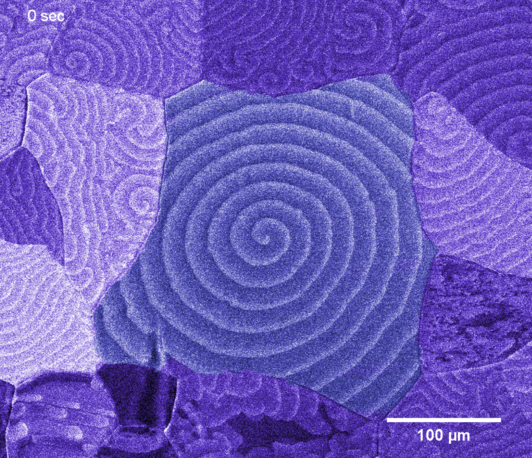
Our aim is to understand processes that lead to the emergence of catalytic function though direct observation using a combination of operando scanning and transmission electron microscopy. Starting with simple model catalysts, such as polycrystalline metal foils, we observe the propagation of chemical waves and reveal how catalytic activity depends on grain orientation, coupling mechanisms and reaction conditions. In the case of redox-reactions on non-noble metals, we find that the active catalyst is operating near a phase-boundary where metallic and oxidized phases co-exist. Real-time imaging reveals fascinating oscillatory redox dynamics that increase in complexity with increasing chemical potential of the gas-phase. When moving from simple model catalysts to industrially relevant metal nanoparticles supported on reducible oxide carriers, we apply in-situ transmission electron microscopy to study effects related to a strong metal-support interaction (SMSI) under reactive conditions. Using the archetypical titania supported platinum nanoparticles as a reference system, and hydrogen oxidation as model redox reaction, it will be shown that the well-described encapsulated state of platinum particles is lost as soon as the system is exposed to a redox-active environment. Structural incoherence at the platinum-titania interface lowers the barrier for redox processes, which give rise to dynamic reconstructions and particle migration. The particle orientation on the support determines the structure of the interface and the resulting particle dynamics, migration, and sintering behaviour. The aim of the presentation is to demonstrate that active catalysts are dynamically adapting to the reaction environment and that catalytic function is related to the catalysts ability to participate in the reaction through reversible changes in its structure and/or (local) composition. [more]
Many of the functional materials we hope to leverage for next-generation technological applications — such as computing, energy harvesting and storage, or communication devices — draw their unique and sometimes exotic properties from a suite of interactions between the atoms, spins, and charges in a crystalline lattice. With direct, real-space access to these order parameters down to the atomic scale, the scanning transmission electron microscope (STEM) is a powerful tool to probe the fundamental framework of such compounds and their properties. As an example of this, I will show how advanced STEM techniques can elucidate key questions about the landscape of superconductivity in recently discovered nickelates. But many of these functional systems are most useful (and therefore interesting) away from the ambient conditions of most typical high-resolution STEM experiments, for instance at cryogenic or elevated temperatures or under an external bias. It is therefore imperative to expand the environmental compatibility of these methods through the parallel development of both hardware and data processing tools, key examples of which will be highlighted here. [more]

Atomistic Dynamics of Deformation, Fracture and GB Migration in Oxides

In order to clarify the deformation and fracture mechanism in oxides such as Al2O3 and STO, TEM in situ nanoindentation experiments were conducted for their single crystals and bicrystals. We successfully observed the dynamic behavior of twin formation, twin-GB interaction, pile-up dislocation, jog and kink formation and jog drag dynamics and so on. The mechanism of each dynamic behavior will be discussed in detail in this presentation. GB migration plays an important role in considering the high temperature mechanical properties. Recently, we have found that GB migration behavior in Al2O3 can be precisely controlled by the aid of the high-energy electron beam irradiation. This technique was applied to directly visualize the atomistic GB migration. It was revealed that the GB migration is processed by a cooperative shuffling of atoms in GB ledges along specific routes. References [1] S. Kondo, T. Mitsuma, N. Shibata, Y. Ikuhara, Sci. Adv., 2[11], e1501926(2016). [2] S. Kondo, A. Ishihara, E. Tochigi, N. Shibata, and Y. Ikuhara, Nat. Commun., 10, 2112 (2019). [3] J.Wei, B.Feng, R.Ishikawa, T.Yokoi, K.Matsunaga, N.Shibata and Y.Ikuhara, Nat. Mater.,20 (7), 951 [4] J.Wei, B.Feng, E.Tochigi, N.Shibata and Y.Ikuhara, Nat. Commun., 13(1), 1455, (2022) [more]
Local Phase Transformations: A New Creep Strengthening Mechanism in Ni-Base Superalloys

Polycrystalline Ni-based superalloys are vital materials for disks in the hot section of aerospace and land-based turbine engines due to their exceptional microstructural stability and strength at high temperatures. In order to increase operating temperatures and hold times in these engines, hence increasing engine efficiency and reduction of carbon emissions, creep properties of these alloys becomes increasingly important. Microtwinning and stacking fault shearing through the strengthening g’ precipitates are important operative mechanisms in the critical 600-800°C temperature range. Atomic-scale chemical and structural analyses indicate that local phase transformations (LPT) occur commonly during creep of superalloys. Furthermore, the important deformation modes can be modulated by LPT formation, enabling a new path for improving high temperature properties. [more]

High-resolution micro-plasticity in advanced high-strength steels

The persistent demand for green, strong and ductile advanced high strength steels, with a reduced climate footprint, calls for novel and improved multi-phase microstructures. The development of these new steels requires an in-depth understanding of the governing plasticity mechanisms at the micron scale. In order to address this challenge, novel numerical-experimental methods are called for that account for the discreteness, statistics and the intrinsic role of interfaces. This lecture sheds light on recent and innovative developments unravelling metal plasticity at the micron scale. Multi-phase through-thickness samples allow for a full characterization of the underlying microstructure. Using computational crystallographic insights, a slip system based local identification method has been developed, which provides full-field crystallographic slip system activity maps. The resulting deformation maps are directly used to assess the model predictions. Heterogeneous spatial variations are introduced by sampling the slip system properties of individual atomic slip planes from a probability density function. This allows to recover naturally localized slip patterns with a high resolution. It is demonstrated that this discrete slip plane model adequately replicates the diversity of active slip systems in the corresponding experiment, which cannot be achieved with standard crystal plasticity models. Recent experimental observations on dual-phase steels demonstrate substructure boundary sliding parallel to the habit plane in lath martensite, for which a habit-plane slip enriched laminate model is developed. This model adequately captures the role of the substructure boundary sliding on the deformation of the martensite aggregate. [more]

Effect of droplets on inhibitor performance for steel and galvanized steel

Effect of droplets on inhibitor performance for steel and galvanized steel

Real-time hydrogen visualization system with high spatial and temporal resolutions: Imaging the preferential hydrogen permeation at grain boundaries of pure Ni

Real-time hydrogen visualization system with high spatial and temporal resolutions: Imaging the preferential hydrogen permeation at grain boundaries of pure Ni
Show more
Go to Editor View