Scientific Events

Pathways towards next-generation batteries

  • Date: Nov 17, 2026
  • Time: 02:00 PM - 03:00 PM (Local Time Germany)
  • Speaker: Prof. Dr. Dominic Bresser
  • Helmholtz-Institute Ulm, 89081 Ulm, Germany
  • Location: Max Planck Institute for Sustainable Materials
  • Room: Large Conference Room No. 203
  • Host: on invitation of Prof. Dierk Raabe / Prof. Gerhard Dehm

Elevated Temperature Deformation Mechanisms in Single-crystalline RMPEAs

  • Date: Oct 15, 2026
  • Time: 11:30 AM - 12:30 PM (Local Time Germany)
  • Speaker: Daniel Magnuson
  • Johns Hopkins University, Baltimore (USA)
  • Location: Max Planck Institute for Sustainable Materials
  • Room: Large Conference Room No. 203
  • Host: on invitation of Prof. Gerhard Dehm
Studies of RT dislocation motion in BCC RMPEAs have evidenced increased activation of higher order slip systems and a multiplicity of slip; a fundamental departure from the dislocation motion in BCC metals and dilute alloys. Single-phase ternary RMPEAs are used as model systems for investigating these novel deformation mechanisms. In this study, the first single-crystals of MoNbTi were grown and tested in tension at temperatures exceeding 1,000oC. Post-mortem slip trace and TEM characterization of deformed specimens, combined with phase field dislocation dynamics (PFDD) simulations, allowed us to confirm the multiplicity of slip at temperatures exceeding 1,000oC and to elucidate the dislocation processes that underpin ultrahigh temperature plasticity in these alloys. [more]

Green metals as recyclable carriers of renewable energy - From global opportunities to combustion physics

Colloquia Series on Sustainable Metallurgy
  • Date: Sep 15, 2026
  • Time: 04:00 PM - 05:00 PM (Local Time Germany)
  • Speaker: Prof. Christian Hasse, Simulation of Reactive Thermo-Fluid Systems, TU Darmstadt
  • Location: University Duisburg-Essen
  • Room: NETZ 2.42 / Hybrid
  • Host: on invitation of Prof. Christof Schulz
  • Topic: Lectures

Microstructural Evolution and Mechanical Properties of Cu-X (X = Sn, Zn) Alloys Processed by High-Pressure Torsion Followed by Short-Time Annealing

  • Date: Aug 12, 2026
  • Time: 01:30 PM - 02:30 PM (Local Time Germany)
  • Speaker: Yuting Dai
  • Karlsruhe Institute of Technology
  • Location: Max Planck Institute for Sustainable Materials
  • Room: Large Conference Room No. 203
  • Host: on invitation of Prof. Gerhard Dehm
High-pressure torsion (HPT) generates ultrafine-grained (UFG) microstructures with high densities of deformation-induced defects, resulting in enhanced mechanical properties but limited thermal stability.In this study CuSn5, CuZn5, and CuZn30 alloys subjected to HPT and subsequent short-time annealing were investigated. ACOM and EDX were used to correlate the grain boundary type with the local distributions of Sn and Zn. The alloys exhibited composition dependent segregation behavior, leading to different degrees of grain boundary stabilization. In CuSn5, Sn segregation occurred at high angle grain boundaries (HAGBs), resulting in stabilization of the microstructure up to 200°C. In CuZn5, the segregation of Zn was deformation-driven, and also stabilized the UFG microstructure, i.e. no grain growth after annealing at 200°C. In the case of CuZn30, the segregation mechanism was reversed and Zn was depleted from the HAGBs. Annealing for several hours resulted in a homogeneous distribution of the alloying elements. These results demonstrate that solute segregation is not only thermally driven but can also be influenced by mechanical deformation. Overall, the segregation of Sn and Zn can enhance the thermal stability of defect rich UFG-Cu alloys. [more]

Tailorable and rare-earth free magnetic materials by severe plastic deformation

Colloquia Series on Sustainable Metallurgy
  • Date: Aug 11, 2026
  • Time: 01:00 PM - 02:00 PM (Local Time Germany)
  • Speaker: Prof. Andrea Bachmaier
  • Erich Schmid Institute of Materials Science, Austrian Academy of Sciences, Leoben, Austria
  • Location: Max Planck Institute for Sustainable Materials
  • Room: Large Conference Room No. 203
  • Host: on invitation of Prof. Dierk Raabe
  • Topic: Lectures
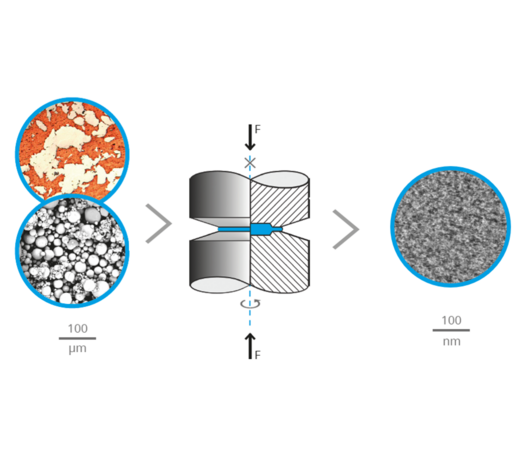
Severe plastic deformation is a well-established method for producing nanocrystalline and ultrafine-grained materials. Among severe plastic deformation techniques, high-pressure torsion (HPT) is particularly versatile. In addition to deforming bulk materials, HPT can be used for mixing, consolidation, and alloying of powders at ambient temperatures through high shear strain. This avoids high-temperature processing steps, such as sintering, which can lead to decomposition, and bypasses the limitations imposed by phase diagrams and traditional metallurgical routes. While HPT has traditionally been used to tailor and study advanced mechanical properties, recent interest has increasingly shifted toward functional properties.In this talk, the use of HPT deformation to synthesize different magnetic materials is in focus. Magnetic properties are strongly governed by microstructure. By selecting different starting materials and controlling grain size, phase distribution and texture formation, HPT provides powerful opportunities to tune magnetic properties. In HPT deformed binary and ternary immiscible systems, soft magnetic properties are obtained. Additionally, the use of the HPT deformation process to synthesize hard magnetic materials and nanocomposites entitling different magnetic coupling mechanisms as well as exchange biased ferro- antiferromagnetic magnets is presented.The research on rare-earth free magnetic materials has increased significantly in recent years, driven by criticality of the strategic rare earth elements. The ferromagnetic α-MnBi phase as rare-earth free magnetic material has gained increasing interest, but the fabrication of large volumes containing a significant amount of α-MnBi is still challenging. Finally, I will address the use of HPT deformation to synthesize the rare-earth free α-MnBi phase from elemental Mn and Bi powders avoiding a large number of different processing steps. [more]

Grain boundary stabilization: thermodynamics or kinetics?

  • Date: Jul 21, 2026
  • Time: 11:00 AM - 12:00 PM (Local Time Germany)
  • Speaker: Prof. Yuri Mishin
  • Humboldt Research Award Winner 2026; George Mason University, USA
  • Location: Max Planck Institute for Sustainable Materials
  • Room: Large Conference Room No. 203
  • Host: on invitation of Prof. Gerhard Dehm
Two approaches have been proposed to slow down grain growth in nanocrystalline materials: the thermodynamic approach, which aims to reduce the grain boundary (GB) free energy, and the kinetic approach, which seeks to reduce GB mobility. Both approaches rely on GB segregation. We argue that the two approaches are inseparable, with one causing the other. The talk discusses the intricate relationships between GB phase transformations, GB diffusion, GB migration, and the recently proposed self-pinning mechanism. [more]

Recent applications of high-energy-resolution STEM-EELS: from phonons and magnons to extra-terrestrial organic matter

  • Date: Jul 17, 2026
  • Time: 11:00 AM - 12:00 PM (Local Time Germany)
  • Speaker: Prof. Quentin Ramasse
  • Director, SuperSTEM Laboratory and Chair of Advanced Electron Microscopy, University of Leeds
  • Location: Max Planck Institute for Sustainable Materials
  • Room: Large Conference Room No. 203
  • Host: on invitation of Prof. Gerhard Dehm
A little over a decade after the first report of vibrational spectroscopy in the STEM, this informal seminar will illustrate the extremely wide impact high-energy-resolution STEM-EELS has had across numerous scientific fields. Beyond headline demonstrations of atomic-resolution phonon or magnon spectroscopy, which provide a unique tool to probe quantum matter and phenomena at device-relevant length-scales, these new instruments have also found cross-disciplinary applications in areas of research as varied as cosmochemistry (with nanoscale vibrational analysis of the molecular constitution of extraterrestrial organic matter in returned samples from JAXA’ Hayabusa2 or NASA’s OsirisREx missions), fundamental inorganic chemistry (with ‘extreme’ encapsulated nano-systems offering atomic-scale ‘test-tubes’ to study gas or molecular interactions a handful of one molecules at a time) or metallurgy with new insights provided into decades old unresolved debates, e.g. concerning heterogeneous nucleation in metallic alloys). With further instrumentation developments on the horizon such as new sample stages reaching temperatures as low as a few K, there is now truly a synchrotron in our microscopes! [more]
Show more
Go to Editor View