Scientific Events

Eine menschliche Hand und eine Roboterhand strecken ihre Finger aus und sind verbunden mit einem rautenförmigen Symbol. Text im Symbol: AI

KopfSalat: Human-machine interaction: Living and working in the age of AI

  • Date: Apr 22, 2026
  • Time: 06:00 PM - 07:30 PM (Local Time Germany)
  • Speaker: Dr. Mengchen Dong
  • Wissenschaftlerin am Max-Planck-Institut für Bildungsforschung, Berlin / Research scientist at the Max Planck Institute for Human Development, Berlin
  • Location: Max-Planck-Institut für Nachhaltige Materialien GmbH
  • Topic: Discussion and debate formats, lectures
  • Contact: kopfsalat@mpi-susmat.de
How do we feel when AI makes important decisions, when it acts as a manager, a public servant, or even a medical doctor? And do people from different social backgrounds and cultures feel the same way? [more]

Advancing In-Situ and ex-Situ Transmission Electron Microscopy with Low Dose Focal Series Reconstruction and 4D‑STEM

  • Date: Apr 9, 2026
  • Time: 01:30 PM - 02:30 PM (Local Time Germany)
  • Speaker: Dr. Idan Biran
  • Technical University of Denmark (DTU)
  • Location: Max Planck Institute for Sustainable Materials
  • Room: BDS Seminar room
  • Host: on invitation of Dr. Siyuan Zhang / Prof. Christina Scheu
Recent advances in transmission electron microscopy (TEM) have pushed spatial resolution into the 0.5 Å regime, shifting imaging from an instrument-limited to an object-limited discipline and enabling the direct visualization of individual atoms and molecules. However, the structures and dynamics of many functional materials, particularly catalysts, are strongly influenced by their local environment, creating challenges for imaging under conventional high‑vacuum and high‑dose conditions. In this seminar, two complementary developments in instrumentation and imaging methodology will be presented, each expanding the capabilities of TEM for both in‑situ and ex‑situ studies. First, open‑cell TEM, also known as environmental TEM (ETEM), will be described. The VISION PRIME platform, built on an ultra-stable SPECTRA ETEM system, will be introduced. Through the integration of a 5th-order aberration corrector, monochromated illumination, differential pumping that enables operation at 10-20 mbar gas pressure, and direct electron detection, a 0.5 Å information limit is maintained even in gas atmospheres. Using Young’s fringes and exit wave phase reconstruction, atomic‑resolution visualization of gas–surface interactions on a Au nanoparticle at 1 mbar N₂ has been demonstrated, revealing gas-dependent variations in atomic column widths and enabling operando studies of catalytic processes. Second, examples of exit wave phase reconstruction obtained using a low dose focal series reconstruction (LD‑FSR) methodology will be presented. This approach enables 1.6 Å‑resolution imaging of organic materials with limited radiation damage to the sample. By rapidly recording hundreds of low dose frames at cryogenic temperatures and reconstructing the exit plane wavefunction, aberration-corrected phase images up to the microscope’s information limit are obtained. In this way, access is provided to organic crystal structures and aperiodic features that would otherwise be obscured under strong defocus conditions and low signal-to-noise ratio. When combined with complementary methods such as density functional theory, reliable determination of molecular packing and local structural distortions is enabled directly from real-space images. Finally, a combined approach employing LD-FSR and 4D-STEM for imaging sensitive organic crystalline polymers will be demonstrated. [more]

Mechanical and Microstructural Control of Dendrite Initiation and Li Plating on Oxide and Sulfide Solid Electrolytes

  • Date: Mar 20, 2026
  • Time: 11:00 AM - 12:00 PM (Local Time Germany)
  • Speaker: Prof. Wendy Gu
  • Standard university, USA
  • Location: Max Planck Institute for Sustainable Materials
  • Room: Large Conference Room No. 203
  • Host: on invitation of Yuwei Zhang / Prof. Gerhard Dehm
Lithium metal solid-state batteries have high potential for safety, energy density, and charging rate beyond that of Li-ion batteries. A major challenge for lithium metal solid-state batteries is the formation of lithium dendrites across the solid electrolyte during cycling, which leads to short-circuiting and mechanical failure of the cell. The reason that dendrites form is not fully understood, but evidence shows that dendrites could initiate either at the surface or within the interior of the solid electrolyte. Here, I present our use of in-situ mechanical and electrochemical testing to investigate dendrite initiation and propagation. Scanning electron microscopy and optical microscopy are used to observe nano to millimeter-scale structural changes in garnet-type oxide solid electrolytes (LLZO) and glassy sulfide electrolytes under mechanical loads and electrochemical charging. We find that dendrite propagation follows Weibull statistics in polycrystalline LLZO. Ag-doped LLZO shows increased resistance to dendrites under elevated mechanical loads due to compressive stress effects at the LLZO surface. Investigations on single crystal LLZO demonstrate that the role of surface flaws in the absence of grain boundaries, and that Li plating can be achieved over large areas. Confocal raman spectroscopy is used to understand chemical heterogeneities within a glassy sulfide electrolyte control the mechanical failure. Lastly, I present the effect of biaxial compressive stress on dendrite initiation and propagation in LLZO. The biaxial compressive stress is applied orthogonal to the electric field generation, and serves to close cracks that extend from the anode, through the electrolyte, to the cathode. This allows lithium symmetric cells to be cycled at current densities up to 100 mA/cm2, for >10,000 cycles, and provides evidence that lithium plating occurs within the interior of LLZO when surface dendrite initiation is suppressed. [more]

Problem found; problem mitigated: overcoming chemical instability in Mg-based thermoelectric materials

  • Date: Mar 3, 2026
  • Time: 02:30 PM - 03:30 PM (Local Time Germany)
  • Speaker: Prof. Johannes de Boor
  • Jun. Professor for ‘Functional Materials and Joining Technologies for Thermoelectric Generators’ at the University of Duisburg-Essen and Group Leader at the German Aerospace Center of Köln (DLR), Institute of Materials Research.
  • Location: Max Planck Institute for Sustainable Materials
  • Room: Large Conference Room No. 203
  • Host: on invitation of Eleonora Isotta and Prof. Christina Scheu
Devices from thermoelectric materials can directly convert heat flows into electrical energy powering autonomous sensors or providing reliable electrical power supply in remote areas, as successfully demonstrated e.g. by the Voyager space probes or the Mars rovers Curiosity and Perseverance. On the other hand, they can also be employed for maintenance-free, seamlessly adjustable and scalable thermal management solutions, e.g. for fuel cells or optoelectronic systems. To unlock further applications of thermoelectric materials alternatives to state-of-the-art bismuth telluride are required. Magnesium-based TE materials like MgAgSb, Mg3(Sb,Bi)2 and Mg2(Si,Sn) are among the most promising candidates due to excellent performance, low cost, and environmental compatibility. However, functional stability under application conditions is an indispensable requirement, which proves to be a significant challenge for many high- performance materials, Mg-based ones in particular. For those, loss of volatile Mg along grain boundaries as well as demixing are the main challenges. Taking Mg2(Si,Sn) as example, we’ll discuss how to derive material transformation mechanisms from readily available experimental data, compare their effect on material transport properties and analyze the influence of environmental parameters (temperature, atmosphere) on the material degradation rate. From this understanding strategies against material instability can be derived effectively and evaluated experimentally. Focussing on Mg loss as the most relevant degradation mechanism we’ll discuss the following approaches: i) controlling the Mg vapor pressure, ii) fine-tuning the Mg content of the material to avoid loosely bound Mg, iii) coating, and iv) grain boundary engineering to stop Mg diffusion. Employing these, material degradation is reduced by several orders of magnitude, resulting in high-performance materials with enhanced stability. [more]

Plasticity and fracture behavior of high-strength steels at low temperatures

  • Date: Feb 6, 2026
  • Time: 11:00 AM - 01:00 PM (Local Time Germany)
  • Speaker: Dr. Fuhui Shen
  • Assistant Professor in the Soete Laboratory at Ghent University, Belgium
  • Location: Max Planck Institute for Sustainable Materials
  • Room: Large Conference Room No. 203
  • Host: on invitation of Prof. Gerhard Dehm
High-strength steels with a body-centered cubic (bcc) crystal structure are generally expected to exhibit limited ductility at low temperatures due to the ductile-to-brittle transition. In this talk, we show that some high-strength bcc steels can nevertheless display unexpectedly large macroscopic plasticity during tensile deformation at cryogenic temperatures, even below their transition regime. A systematic tensile testing campaign across temperatures and stress states reveals strongly coupled effects on damage and fracture, which are captured using a mechanism-informed continuum damage model with implications for structural materials in extreme environments. [more]

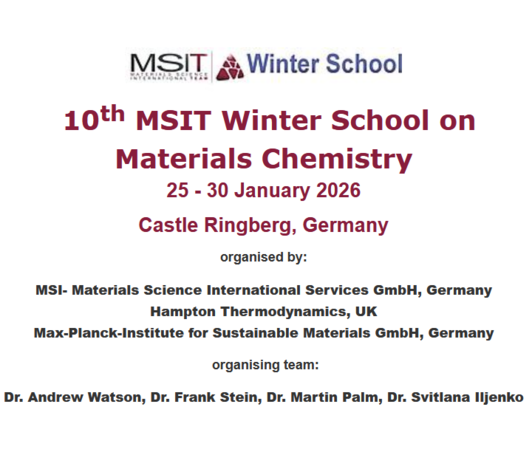
“10th MSIT Winter School on Materials Chemistry”

  • Start: Jan 25, 2026
  • End: Jan 30, 2026
  • Location: Ringberg Castle, Kreuth, Germany
  • Host: Dr. Andrew Watson, Dr. Frank Stein, Dr. Martin Palm, Dr. Svitlana Iljenko

Nanoengineering of high strength steels

  • Date: Jan 23, 2026
  • Time: 01:30 PM - 02:30 PM (Local Time Germany)
  • Speaker: Univ.-Prof. Wenwen Song
  • Institute of Materials Engineering, University of Kassel
  • Location: Max Planck Institute for Sustainable Materials
  • Room: Large Conference Room No. 203
  • Host: on invitation of Prof. Gerhard Dehm
The diversities in crystalline structure and the hierarchical features of the structures in steels lead to their distinguished deformation behaviour, elastic properties, magnetic properties, mechanical properties, etc. In the research of steels, the linkage of structure-processing-property-performance-circularity is considered as the very important principle to understand the alloys. Following this basic principle, one can further design, select and assess suitable materials for a specific application. Over the last decades, based on multi-scale understanding - from metre to micrometre and further down to nanometre and atomic-scale, a number of extraordinary steels have been successfully developed and commonly applied globally. This research work will present the alloy design, multi-scale characterization and nano-engineering approaches that offer new opportunities to design and engineer the sustainable steels into hierarchical structures with tailored properties. New approach that aid controlling the process of phase transformation in tramp element tolerant steels will be discussed. [more]
Go to Editor View